Showing posts with label Part:B. Show all posts

Sunday, December 1, 2013

Part B, General George S. Patton

This Article is from the History Channel Web Page.


Educated at West Point, George S. Patton (1885-1945) began his military career leading cavalry troops against Mexican forces and became the first officer assigned to the new U.S. Army Tank Corps during World War I. Promoted through the ranks over the next several decades, he reached the high point of his career during World War II, when he led the U.S. 7th Army in its invasion of Sicily and swept across northern France at the head of the 3rd Army in the summer of 1944. Late that same year, Patton's forces played a key role in defeating the German counterattack in the Battle of the Bulge, after which he led them across the Rhine River and into Germany, capturing 10,000 miles of territory and liberating the country from the Nazi regime. Patton died in Germany in December 1945 of injuries sustained in an automobile accident.

Contents


George Patton's Early Life and Career

George Smith Patton was born in 1885 in San Gabriel, California. His family, originally from Virginia, had a long military heritage, including service in the Civil War. Patton decided early on that he wanted to carry on the tradition, and graduated from the U.S. Military Academy at West Point in 1909. Patton gained his first real battle experience in 1915, when he was assigned to lead cavalry troops against Mexican forces led by Pancho Villa along the U.S.-Mexico border. He served as aide-de-camp to General John J. Pershing, commander of American forces in Mexico, and accompanied the general on his unsuccessful 1916 expedition against Villa.

When the United States entered World War I in 1917, Patton went along with Pershing to Europe, where he became the first officer assigned to the newly established U.S. Tank Corps. He soon earned a reputation for his leadership skill and knowledge of tank warfare, particularly after U.S. and British troops emerged victorious from the first major tank battle at Cambrai in France. After the war, Patton served positions in tank and cavalry units at various posts in the United States. By the time the country began to rearm itself in 1940, he had risen through the ranks to colonel.

General Patton in World War II: North Africa and Sicily
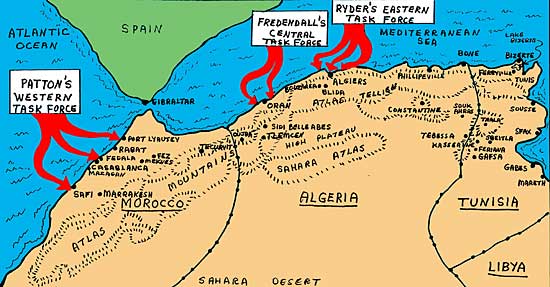
Soon after the Japanese attack on Pearl Harbor in December 1941, Patton was given command of the 1st and 2nd Armored Divisions and organized a training center in the California desert. Patton headed to North Africa late in 1942 at the head of an American force; before the initial landings on Morocco's Atlantic coast, he presented his troops with an expression of his now-legendary philosophy of battle: "We shall attack and attack until we are exhausted, and then we shall attack again." Patton's lust for battle would earn him the colorful nickname "Old Blood and Guts" among his troops, whom he ruled with an iron fist. With this formidable aggression and unrelenting discipline, the general managed to put U.S. forces back on the offensive after a series of defeats and win the war's first major American victory against Nazi-led forces in the Battle of El Guettar in March 1943.

A month later, Patton turned over his command in North Africa to Gen. Omar Bradley in order to prepare the U.S. 7th Army for its planned invasion of Sicily. The operation was a smashing success, but Patton's reputation suffered greatly after an incident in an Italian field hospital in which he slapped a soldier suffering from shell shock and accused him of cowardice. He was forced to issue a public apology and earned a sharp reprimand from President Eisenhower.

General Patton in World War II: France and Germany

Though he had greatly hoped to lead the Allied invasion of Normandy, Patton was instead publicly assigned command of a fictitious force that was supposedly preparing for an invasion in southeastern England. With the German command distracted by a phantom invasion of Pas de Calais, France, the Allies were able to make their actual landings on the beaches of Normandy on D-Day (June 6, 1944). After the 1st Army broke the German line, Patton's 3rd Army swept through the breach into northern France in pursuit of Nazi forces. Late that year, it played a key role in frustrating the German counterattack in the Ardennes during the massive Battle of the Bulge.

In early 1945, Patton led his army across the Rhine River and into Germany, capturing 10,000 miles of territory and helping to liberate the country from Nazi rule. In the months following Germany's surrender, the outspoken general caused another firestorm of controversy when he gave an interview criticizing the Allies' rigid de-Nazification policies in the defeated country; Eisenhower removed him from command of the 3rd Army in October 1945. That December, Patton broke his neck in an automobile accident near Mannheim, Germany; he died in a Heidelberg hospital 12 days later. Patton's memoir, titled "War As I Knew It," was published posthumously in 1947; his larger-than-life persona later made its way to the silver screen in an Academy Award-winning 1970 biopic starring George C. Scott.

Video From Youtube:
National Archives and Records Administration

The General George S. Patton Story

Department of Defense. Department of the Army. Office of the Deputy Chief of Staff for Operations. U.S. Army Audiovisual Center. (ca. 1974 - 05/15/1984)

© 1996-2013, A&E Television Networks, LLC. All Rights Reserved.

PART B, MMHMMM French Toast

This article was derived from Yahoo!shine, initially posted by Food52.

Bell-less, Whistle-less, Darn Good French Toast


Bread. Eggs. Cream. Butter. Just your run-of-the-mill ingredients, right? They're probably sitting on your shelf right now, happily embracing their plain-ness and versatility, looking safe and unassuming in their shades of beige.
That's about to change.

>>RELATED: See more recipes with just five ingredients or less.

It's about to change because said bread, eggs, cream, and butter are about to be made into Bell-less, Whistle-less, Darn Good French Toast (the winner of Your Best French Toast contest). The recipe cuts to the chase, forgoing spices and extracts, focusing instead on said eggs, cream, bread (challah bread), and butter. You whip together the eggs and cream, which form a custardy mixture, then dip the eggy bread into this custard, making sure to gently squeeze the bread with your fingertips to draw the eggs and cream to the center. Then, you fry the bread in butter. Outside is a crisp crepe-like shell. Inside, pudding. What are you waiting for?

>>RELATED: 9 Breakfast Recipes that are Good Enough for Dinner

Making French Toast

Bell-less, Whistle-less, Darn Good French Toast by Kayb

Serves 4
1 loaf challah bread
3 eggs
1/2 cup heavy cream
butter, for grilling and serving
Good maple syrup, for serving
1. Slice challah into 3/4 to 1-inch thick slices.
2. Whisk together eggs and cream.
3. Heat a griddle or flat grill pan over medium high heat, and add 1 tbsp butter for every two pieces of French toast it will accommodate; swirl butter around to cover surface.
4. Dip slice of bread in egg and cream; flip and repeat. Add to griddle, and grill until golden (approximately 90 seconds) on one side; flip and repeat.
5. Serve with additional butter, if desired, and good quality maple syrup. The experience is enhanced with the addition of good quality smoked bacon.